Interviewing Father Flynn of Doubt: A Parable – Sam Rigerman

Standard

Samuel Rigerman is a freshman enrolling in Business Administration, with a dual certificate in Musical Theatre at GCC. Doubt: A Parable was his 17th theatre production so far, having participated in 9 shows during high school and a few other at Harvester 56 Theatre and Rochester. Last semester (Fall 2019), he portrayed Brad Majors in the Richard O’Brien’s musical The Rocky Horror Show. at GCC’s Stuart Steiner Theatre.

(You can read a summary of Doubt: A Parable here.)
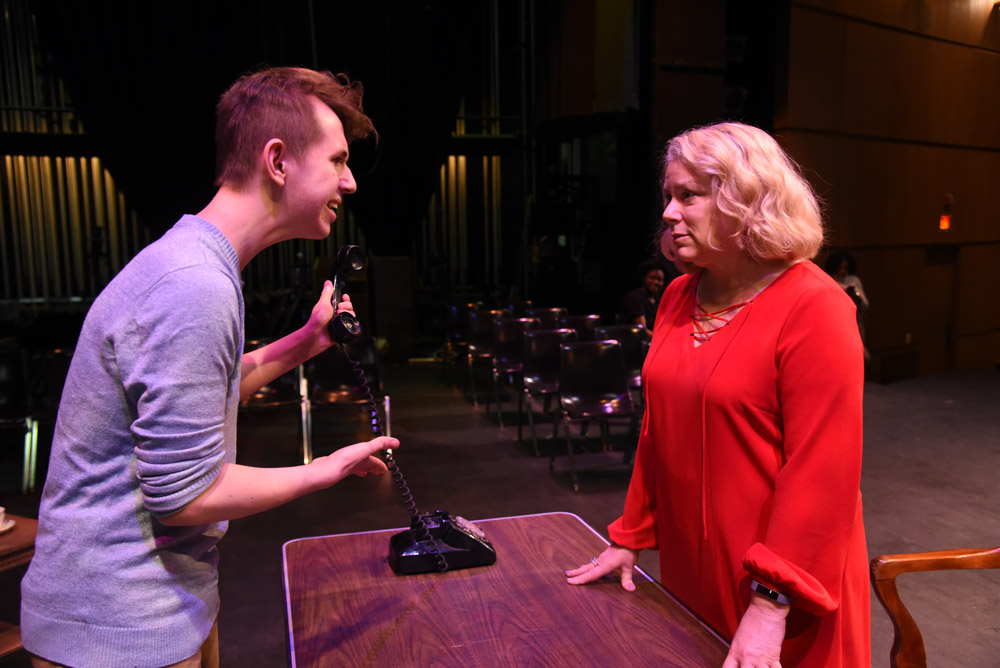
Sam Rigermand and Lucine Kauffman as Sister Aloysius during rehearsal.

For an actor, auditions are always nerve-wracking, “especially with this show, I really wanted to work with director Marianne because she’s an amazing director and this would probably be my one-and-only shot at this time. So I really did all my homework to maximize my chance of getting the role.”

In preparation for the role of Father Flynn, Sam went to different Catholic Churches to watch prescript sermons, “some of the sermons were really boring ’cause they weren’t very good at delivering it, but I learned a lot and took away what I want or did not want in my sermons to apply my own tweaks to Father Flynn’s sermons.” He added, “to prepare for the storytelling section of the Father Flynn’s first sermon in the play, I sat in at the local Richmond library and listened to the women there reading stories to the kids. I tried to learn how she relates to the kids, projected the story so I can take that into my sermons and differentiate between story telling and giving a sermon.”

Some of his difficulties during rehearsals were delivering sermons, where he had to act as if there’s an audience listening when there is no one. The cast didn’t have a real audience until the first performance. “I also struggled a little with the second scene where Father Flynn teaches basketball to the kids, two things of which I don’t know how to do: playing basketball and talking to kids.

He said he also loved the intense scene between Father Flynn and Miss Aloysius. They were verbally battling each other back and forth: Father Flynn criticizes that she has no evidence, but Miss Aloysius is so adamant that she has him cornered and he just trying to get away from it. Sam added, “I love the actress Lucine Kauffman who played Miss Aloysius, she was so fun to work with. We created a bitter connection and really made the scene our own.”
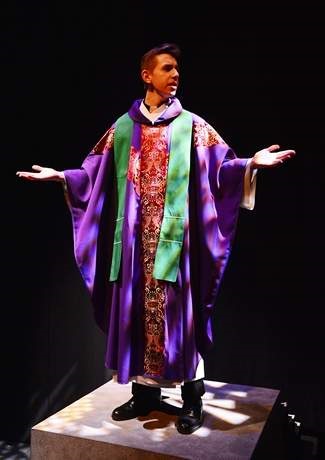
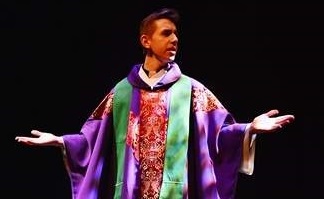
(Photo: Mark Gutman / Daily News) Sam Rigerman as Father Flynn during his first sermon.

On deciding whether Father Flynn was innocent, Sam explained, “After I was cast, director Marianne told me to craft a ‘Who Am I’ statement. It took me a very long time to decide that Father Flynn was innocent. I had to keep reading the script, dig for different clues and find little things that indicate ‘Oh, he did do it’ ‘Wait no, he didn’t do it.’ I kept building on the clues, I finally concluded that he did not do it, and I acted throughout the show with the mindset that Father Flynn is innocent.”

“My reasoning for his resignation after hearing Miss Aloysisus ‘s threat is that he might have had a dark history that he does not want to be revealed. So he simply withdrew and transferred to avoid any further troubles, but he is innocent regarding matters with Donald (the kid suspected of being abused by Father Flynn)”

Sam’s analysis and portrayal of Father Flynn’s character partially correlates to his own personality, “I try to see the good in people, and the same goes for character Father Flynn. Even when someone is accused of something, I’d try to think of a possibility that they didn’t do it. I am aware that such horrific incidents of sexual misconduct have been brought up / revealed over the past 50-60 years in Catholic Churches, which is really hard to process.”

“If I were to play the character again, I’d still portray him as not guilty, but it’d be interesting to pursue the role in the opposite direction, that he is guilty and being manipulative toward sister James. But I would definitely have discomfort portraying him as guilty because it’s a very real and horrible incident that kids are subjected to at such a young age.”

Contrasting his portrayal of Father Flynn in the show versus Philip Hoffman’s portrayal of Father Flynn in the 2008 film, “I think Philip Hoffman portrayed Father Flynn as guilty. But for my portrayal, I wanted the audience to walk away with their own inner conflict of did he do it or did he not do it. One of the great things I think we succeeded at was that people walking out of our show not knowing if he did it or not. That’s the whole point of the show, that you’re filled with doubts about him.”
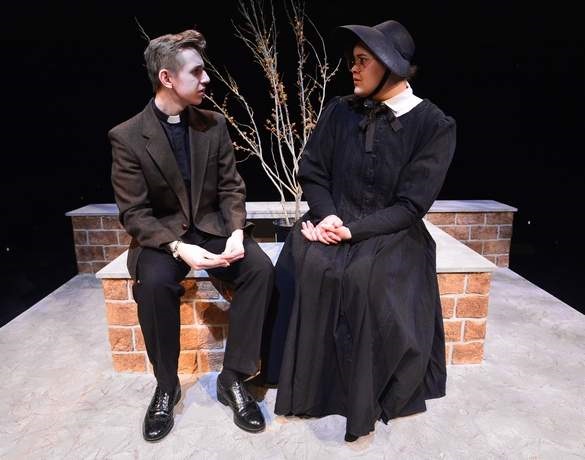
(Photo: Mark Gutman / Daily News) Sam Rigerman as Father Flynn and Alyssa Young as Sister James

Of the two production he had done so far this year, Rocky Horror and Doubt, Sam feels more attached to the production of Doubt and character Father Flynn, “Rocky horror was a lot of fun with many great musical scores, but Doubt, for me, was much more personal, especially when the cast was so close to the audience who sat on stage watching it. I am more attached to Doubt because the plot is real, it’s based on something that realistically happened in real life.”

Through Doubt, he was able to learn and apply many new techniques on character development and analysis, “Unlike character Brad Majors I played in Rocky Horror Show where the single-dimensional character only had one goal: being terrified and trying to get out of the Frank-n-Furter house, Father Flynn in Doubt is a more complex character where he pursues different small objectives in each scene to serve a bigger one. With Doubt, I learned more in-depth about creating a character and analyzing a script by finding the operative word, breaking down each of my monologue/scene into beats of action, I didn’t have to do that for Brad in the Rocky Horror.”
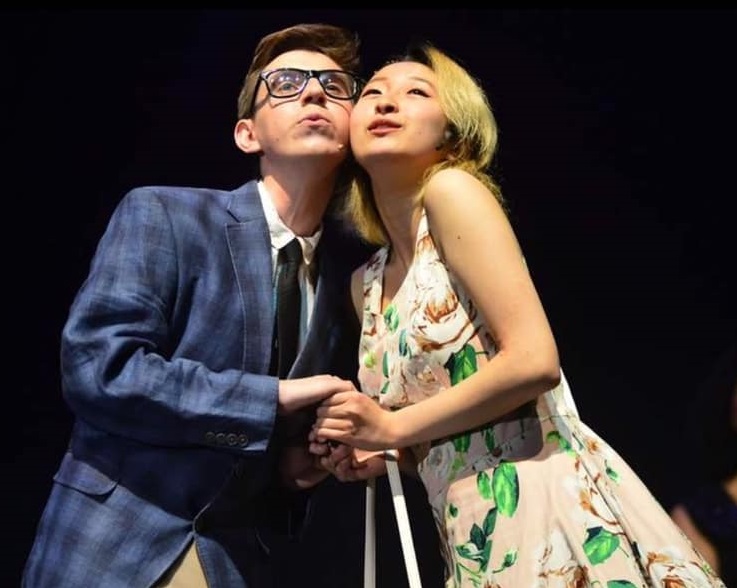
(Photo: Facebook) Sam Rigerman as Brad Majors and Runo Suzuki as Janet Majors during The Rocky Horror Show

Summarizing his experiences here at GCC so far, Sam shared that his favorite theatre course was Theatre 103 – Fundamentals of Acting, taught by Instructor Maryanne Arena, who was also a co-director of Doubt along with her daughter, Jamie, who teaches theatre at Geneseo College. “We learned about audition techniques, character development and a ton of super fun improv games, which is something I didn’t learn from high school theatre or community theatre. I also love my business courses, especially BUS 101 & 213, because Instructor Lauren Paisley of both of those courses is an awesome teacher. “

“I initially chose GCC because it’s close to home, it’s affordable and I can still stay at my job at Starbucks. Another major factor was because I auditioned for and was cast as Brad Majors, one of the lead roles, for Rocky Horror show last May when I was still in high school, so I decided to come here.”

What’s next for Sam? He’s preparing for the play Jack and the Beanstalk in this upcoming May and still has another year with GCC until his graduation in Spring 2021. “After GCC, I plan on transferring to Geneseo College or Colombia University with a BA or BFA/MFA, definitely with theatre component attached with it. My dream job is acting, but if that doesn’t work out, I will pursue a career that connects social media and theatre.”


Little fun facts:

  • The original set design planned that Father Flynn would be giving his sermons among the rows of audience off-stage, instead of on-stage where Sam was standing, but that didn’t work out so the audience sat directly on stage.
  • For his character Father Flynn who had long nails, Sam, who had never worn fake nails before, wore and kept on long acrylic nails everywhere he went (to class, to rehearsals…) the weeks before the performances.

This interview was edited for length and clarity.
Celebrating Vietnamese Lunar New Year: Tết

Standard

By Pinn Duong

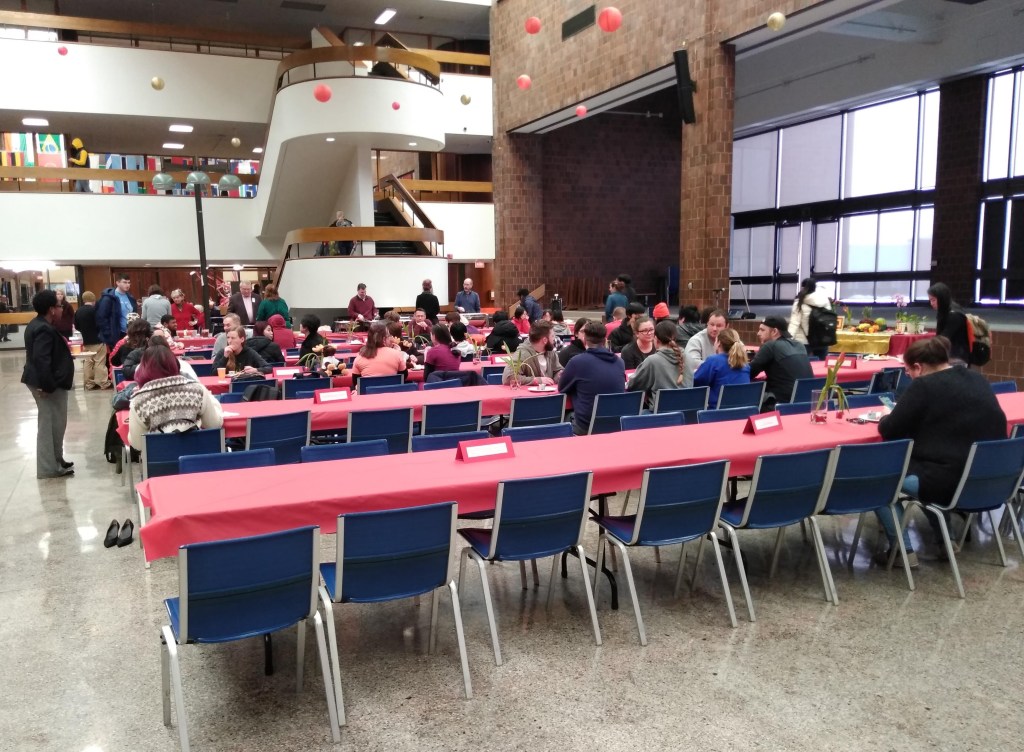
Global Education Committee celebrated Vietnamese Lunar New Year, also known as Tết, on February 13th at GCC. Carefully prepared by Nina Mortellaro from the Human Communications & Behaviors Department and with the help of other faculty from the Global Ed Committee, the event was filled with many authentic dishes, symbolic decorations and traditions of Vietnamese Tet.

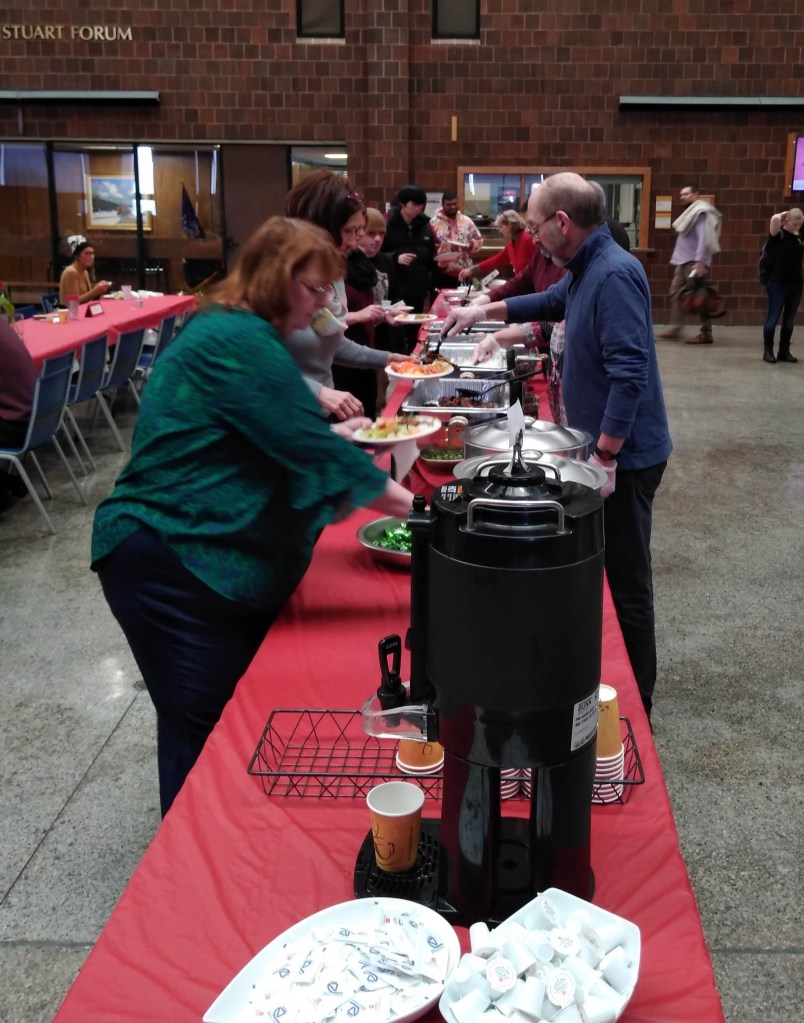
The flavorful dishes were prepared and delivered by a Vietnamese restaurant, SEA, all the way from Rochester. The menu included many popular recipes in Vietnam, but might be rare to find in Western New York, such as fried spring rolls, crispy noodles complemented with dipping fish sauce and peanut sauce with both vegetarian and non-vegetarian options.  

Fried spring rolls & crispy noodles
Peanut dipping sauce & fish dipping sauce

To aid the festive mood of Tet holidays, Nina arranged an altar to represent the ancestral altar that is presented in every family household during Tet. Just like Vietnamese traditions, the altar consists of a five-fruit tray, candles and a variety of flowers that resembles the Tet’s ancestral altars.

Nina Mortellaro – the mastermind behind the event

The five-fruit tray (mâm ngũ quả) is an integral part of Vietnam’s Tet that can be seen through every region of the country. It consists of fruit of different colors displayed in an artistic and coherent arrangements. Traditionally, the five types of fruits resemble the harmonious colors of oriental nature elements: metal, wood, water, fire, and earth. But many households or localities have deviated from the strict ancient rules and modified the variety of the fruits as they seem fit. 

Five-fruit tray (mâm ngũ quả) during Tết

Beside the charming orchids that were presented at the event, Vietnamese also embellish their houses and streets every Tết with yellow and pink apricot, peach blossoms, marigold, or Marumi Kumquat.

(Photo: GonExp) Dazzling flower market during annual Tet 

Adopted from Chinese Lunar New Year traditions, Vietnamese elders would gift children red envelopes of lucky money (or lì xì in Vietnamese) to little children and young adults. The attendees at the event also received a surprising token of lì xì from the Global Education Committee. 

“Lucky evelope” from Global Education Committee

I was surprised to learn that GCC currently has four students from Vietnam, including me. To see and experience our culture being celebrated and shared 8,870 miles from our home country was such a delight at a small and close-knitted community such as GCC.

“Chúc bạn đại cát đại lợi”
May you have great forutne and great profit.

Event photos taken by Donald Lockwood (MarCom student assistant). Featured image by shutterstock; food images taken from Internet / Google.

“The Human Condition” Exhibit at GCC’s Library

Standard

By Donald Lockwood

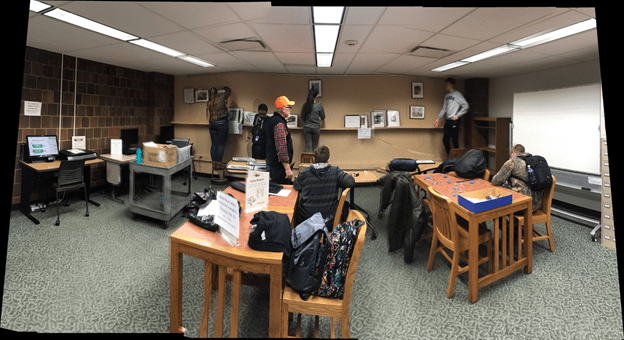
Students hanging the exhibit with Club Advisor and Professor Joe Z.

Starting today, February 13, 2020, the GCC Photo Club is having a photography show in the library called, “The Human Condition.” It is called the human condition because it is showing that humans only have a finite time on earth, and they should enjoy every second of it.

This is the artist statement by Joe Ziolkowski, GCC’s associate professor of photography and art:

“There is one inevitable result that happens to all humans the moment they are born. At some point they will inevitably die. The amount of time we spend on this planet called Earth is finite. We might realize this as we grow older, or we might realize it at a younger age, but at some mark in our personal history we step back and realize, there is only so much time left in a lifetime. It is up to us, and the other humans we share this planet with, to use that time wisely. The human species is capable of creating such amazing advancements in a variety of areas, and on the flip side we are also capable of creating such unbelievable atrocities. We evolve out of ignorance, and learn from that. But that action can also put us in a new ignorance of another topic. The cycle of education perpetuates ignorance in unfamiliar areas that we learn and evolve into creating a new state of consciousness and awareness.

The human condition is a topic for this show to inform the members of GCC Photo Club at SUNY Genesee Community College of this important topic. It helps them reflect on the time we are here and take precedence to make the most of the time we have. In classes and the clubs they participate in, students build relationships with their peers, hopefully bridging intercultural competency and long lasting relationships. 

Put aside the differences we might have, the polarizing topic of the day in politics, religion and economic status, all of which are part of the human condition. Let us look at the complexity of being human and the amazing feelings that are generated with the relationships we have with others, and the creativity that we are capable of generating and sharing.”

– Joe Ziolkowski

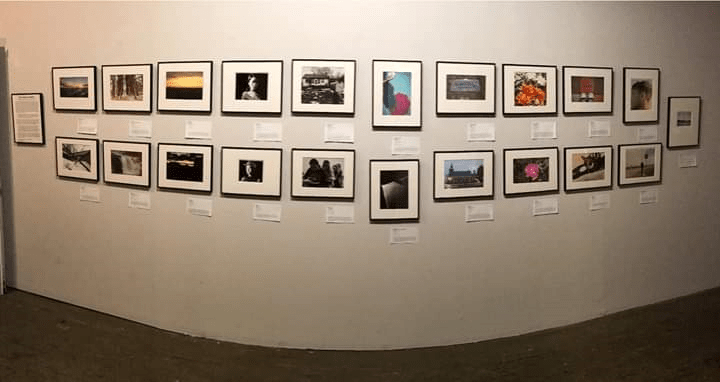
            The show put on by the Photo Club will be up in the library until March 19, 2020. I highly suggest seeing the exhibit. It is an amazing show developed by an exceptionally talented group of students this year. The group just had this show up in Rochester at the Anderson Art Gallery, 250 N. Goodman Street, Rochester 14607 adjacent to Colleen Buzzard’s Studio. She generously allowed the students to use one of the walls outside her studio. She has done this for the students in the past and always enjoys interacting with students.

The Human Condition Exhibit at the Anderson Gallery in Rochester,
now located in GCC’s Library

Photo provided by Zoe Ziolkowski

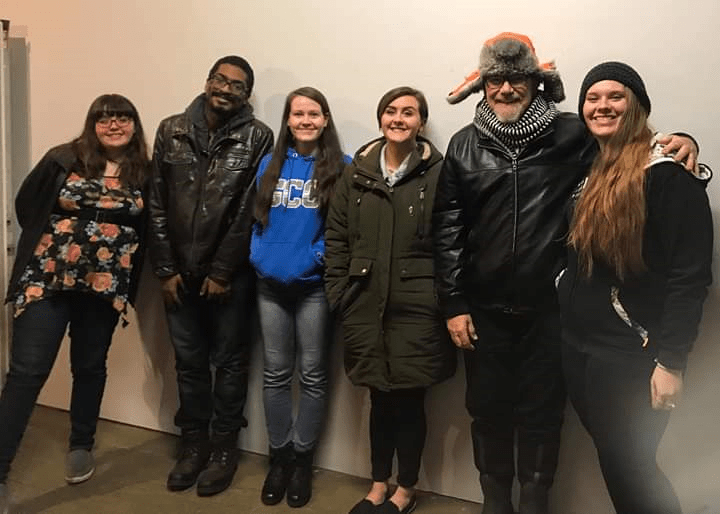
Photo Club students at the Anderson Gallery with Professor Joe Z (second from right).

How is your Heart doing?

Standard

By Pinn Duong

February is not only the time to give out hearts to your loved ones, but also the time to take care of your own heart. February is American Heart Month, first proclaimed by President Lyndon B. Johnson in 1964 to raise awareness and urge Americans to adopt a healthy lifestyle against the battle of heart diseases. As the leading cause of death for both men and women in the US and globally, American Heart Month pays tribute to health professionals, researchers and volunteers for their tireless battle in preventing and treating heart patients.

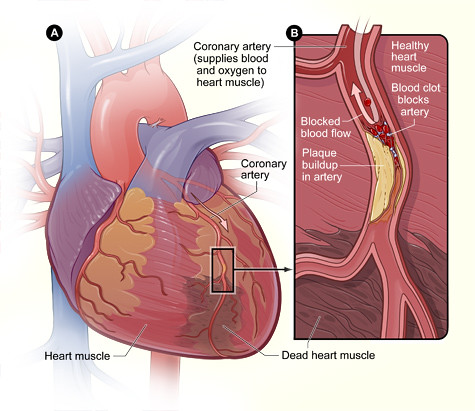
Image result for blood clot artery heart
(Image: National Institutes of Health) Blood clotting in artery

Heart diseases spare no one, not even the youth. The good news is that 80% of heart diseases are preventable. Below are some age-old critical reminders to ‘stay young at heart’, and prevent it from aging prematurely:

  • Keep a hearty diet of low-trans fat, low-saturated fat, low-sugars, and low-salt foods. 90% of Americans are consuming too much salt via pizza, pasta dishes, cold cuts, chicken and yeast breads, which are the top 5 foods that dominate American salty diet.
  • Stay active with two to three sessions of 10-15 minutes of exercises through out the day. Being active doesn’t mean toiling in the gym for hours. Something is always better than nothing; don’t give into the taking the elevator when you can take the stairs.
  • Track your numbers on weight, blood pressure and cholesterol.
  • Manage a healthy weight.
  • Screen for diabetes, which can lead to heart disease if left untreated.
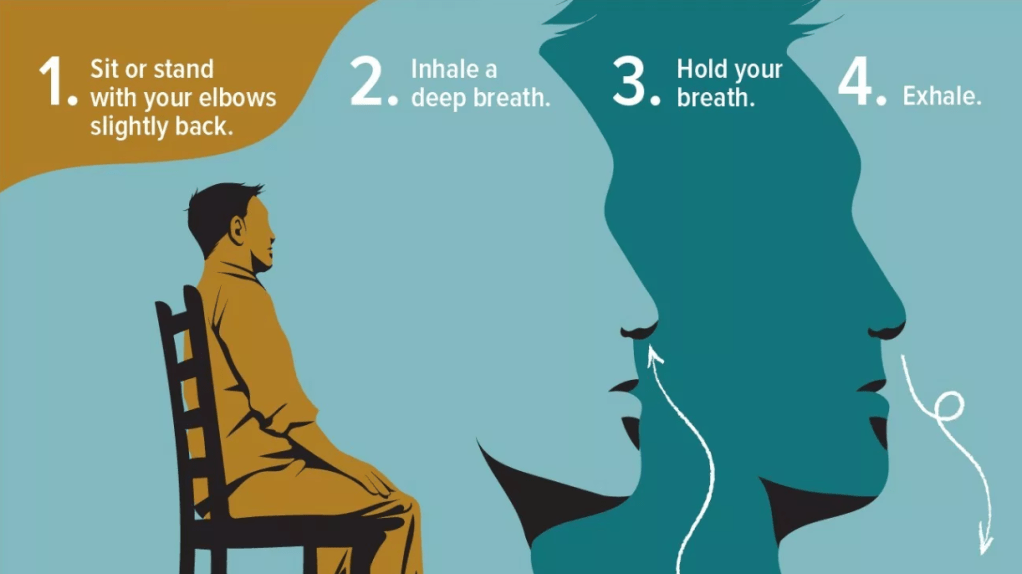
  • Manage stress via mediation, exercise, and healthy relaxing techniques. Coping with stress using alcohol, smoking, or overeating is a huge no-no. You can even manage stress with proper breathing techniques for just 10-20 min /day. Laughing can increase healthy blood flow through your body by 22%.
  • Keep a high-quality sleeping pattern to restore your body and mental health. Sleep deficiency promotes weight gain, diabetes, and cause low-grade inflammation inside blood vessels that lead to heart diseases
(Image: Healthline)

Say NO to:

  • Smoking. The nicotine in smoke reduces how much oxygen your heart gets and raise the risks of blood clots.
  • Excessive alcohol use. Overdrinking alcohol causes irregular heartbeats (called atrial fibrillation), which increases your risks of stroke, heart attack or heart failure. The American Heart Association suggests no more than one drink per day for women and two for men.

FUN FACTS

  • Newborn babies have the fastest heart beats of 70-190 / min while an average adult has a resting heart rate of 60-100 beats / min. A regularly trained athlete has an even slower resting heart rate of 40-60 beats / min.
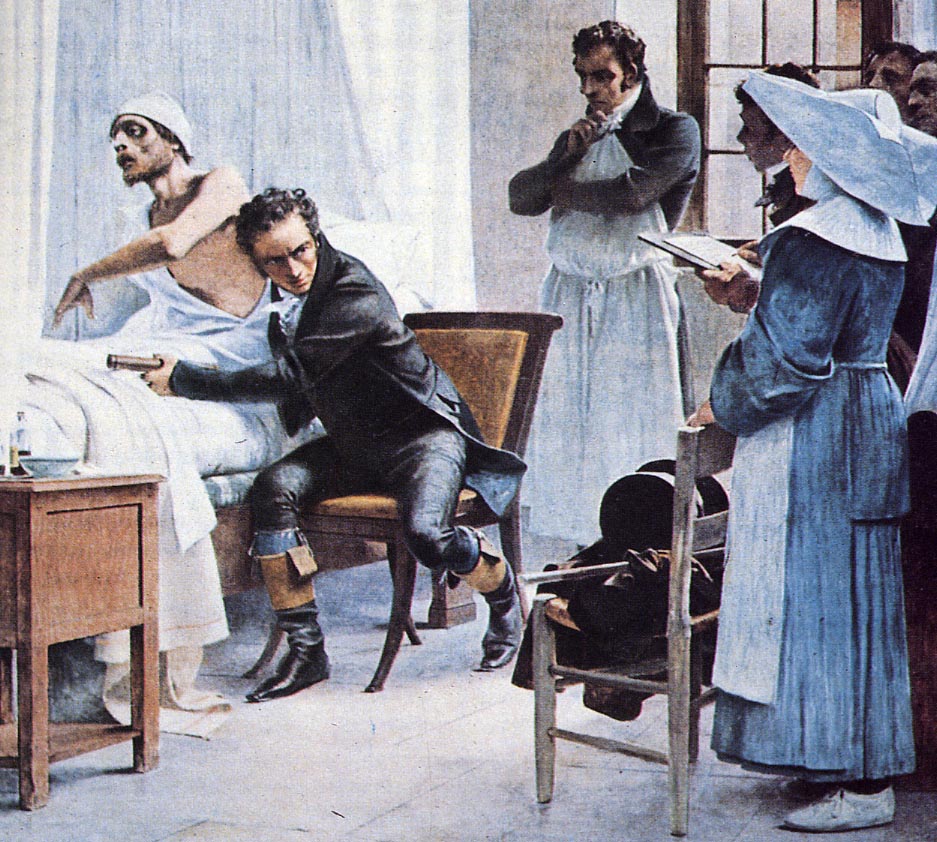
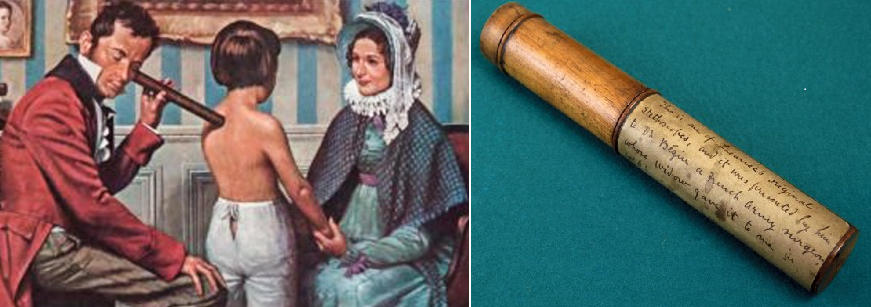
  • Before the invention of stethoscope, doctors had to press their ears into the patient’s chest to detect heart beats.
(Painting by Théobald Chartran, 1816)
(Image: Science Museum London) After the original stethoscope was invented by René Laennec.

NOT-SO-FUN FACTS ABOUT HEART

  • One person dies every 37 seconds in the US from cardiovascular disease. By the time you finish reading this blog, we might have lost another six Americans to heart disease.
  • Heart attacks happen most often on Monday mornings. A rise in stress hormones and blood pressure cause heart blockages.
  • Heart attacks peak on Christmas Day, Dec 26th and New Year’s.
  • Your heart works twice as hard as the leg muscles of a sprinter. So do take care of your heart and give it a lot of love.

Source(s): https://www.unitypoint.org/livewell/article.aspx?id=20b07ab0-e855-49c6-9ee2-91247e52d5cc

Featured image: designed by Freepik.