Tech tips in the Digital Age

Standard

By Pinn Duong

In this rushed and overloaded digital age, speed and productivity is power. Some of the tech tools below can be the very hacks you need for productivity so you can optimize your time and effort, and save more quality time for more quality tasks. 

Unroll.me

Unroll.me makes it super easy for you to unsubscribe from junk / spam emails without having to delete them manually so often. When you sign up for the service, it will scan through your email to display a list of subscriptions that are filling up your inbox, including subscriptions that you never knew you signed up for. It also helps to remove scam emails whose unsubscribe button doesn’t actually work.

It helps you waste less time skimming and sorting through your crowded mailbox every day.

  • Available as: website
  • Charge: Free

Canva 

“The design tool for non-designers,” this popular web-based graphic design platform allows users to create their own designs & customize graphics, prints, presentation slides from hundreds of professional layouts and templates. If you would like to create an eye-catching poster for an event or an enviable presentation without spending too much time or dabbing into more complicated software such as Adobe, Canva is the place.

For an individual who’s looking to create a quick professional-look design, free version of Canva is plentiful. You can compare their free & upgraded features here. Also, you’ll need to sign up for Google or Facebook account before using.

  • Available as: website & app (ios & android)
  • Charge: Free & paid
Plenty of design templates from Canva

Print Friendly 

As the name suggests, the service helps you remove any navigation, ads, and junk to print a clean-looking article. You can also customize or delete the text and image deemed unnecessary before printing.

Equally important, if you don’t read the New York Times article frequently enough but already exceeded your limit of 10 free articles per month, you can paste the blocked article link into Print Friendly and see its entirety.

  • Available as: website & browser extension (chrome & firefox)
  • Charge: Free
A blocked New York Times article which requires subscription to view
Goes to Print Friendly and paste the article link, the whole article is viewable!

Scanner Pro 

There is a good reason why this app is ranked at #2 on IOS App Store for Business category. Scanner Pro produces top quality scans, offering accurate intelligent character recognition (detects readable text and convert them into machine-encoded text), and doing it all with a smooth interface. It automatically detects borders, reduces distortions, lets you export it as jpg and pdf and share/upload right inside the app.

Since using this app, I feel like those bulky document scanner in the office and library will become museum artifacts in the near decades.

  • Available as: app (ios)(there are many different apps on both ios & google play store for the same purpose of different price range for you to pick from)
  • Free & Paid (one-time payment of $3.99)

Video speed controller

In this overwhelming information age, speed listening is the trick to learning more and quicker from multimedia such as videos and podcasts. If you find it torturous and distracted to sit and listen to an online lecture/video of a slow pace, or if you’re more engaged and focused in high-speed informative listening, this video speed controller is a must. A video speed controller also helps you quickly ‘skim’ through unimportant video sections without skipping/missing its main points. Equally important, this extension allows you to customize hotkey (keyboard shortcuts) to increase/decrease speed and skip forward/backwards without touching the mouse.

  • Available as: Chrome browser extension (Firefox also has similar add-on)
  • Charge: free

Pop-up dictionary/translator

If you’re learning a new language or looking to improve your vocabulary through voracious reading, pop-up dictionary and translator helps to reduce interruptions of looking up a word. There are multiple chrome extensions available for this feature, including but not limited to, Good Word Guide, Dictionarist, Google Dictionary (multiple languages). Personally, I used 3 different pop-up dictionary extensions so that I can be exposed to different ways a word is defined.

  • Available as: Chrome browser extension (Firefox also has similar add-on)
  • Charge: free
Google pop-up translator from Chinese to English
Multiple pop-up definitions from different apps

I have personally used all the tools listed in this blog, and have loved them enough to recommend them to you! I hope you find them useful as well!

Feature image: vector created by Rawpixel from freepik.com
Celebration of the Lights: Hanukkah & Kwanzaa

Standard

By Pinn Duong

On December 3rd, Global Education club at GCC held a cultural event called “Hanukkah and Kwanzaa” to share with the students the different ways Jewish-Americans and African-Americans celebrate the end of a year, with free food and free books! It was the event I needed to destress during the final week of classes, especially when the dishes of delicious cookies tamed my sugar cravings.

GCC hard-working staffs feeding the students with sweet treats during finals week!
Free books!

But I swear I was not just there for the colorful sucrose, I also picked up some awareness on year-ending cultural celebrations of the Jews and Africans, and I’m not talking about Christmas.

HANUKKAH (or Chanukkah)

Also known as the “Festival of Lights,” Hanukkah is an eight-day celebration inspired by a Miracle that occurred after the Maccabees successfully revolted and chased the Greek-Syrian oppressors out of Jerusalem during the second century BC. While rebuilding the (holy) Second Temple, the only remaining candle, which was supposed to last a single day, continued to flicker for eight nights and provided light long enough for the Maccabees to gather supplies. This ‘miracle’ illustrates the divine intervention of light amid spiritual darkness.

Hanukkah observers light each of the eight candles each night while the central ninth candle (called the “shamash,” means helper) is used to light the other candles. The candle holder is uniquely called ‘menorah.’ During Hanukkah, Jewish observers eat fried foods cooked in oil to represent the oil that burned the remaining candle miraculously for eight evenings (1).

Hanukkah with 9 candles on a “menorah” (a nine-branched candelabrum)

KWANZAA

Kwanzaa holiday was introduced by professor Maulana Karenga in 1966 to unify African-Americans in faith and endurance amid social and cultural unrest of poverty and police brutality.

In Swahili language (an Eastern African language spoken in Kenya, Uganda, Tanzania, Mozambique and Zimbabwe …) Kwanzaa means ‘first fruits’ or first harvest. Celebrants decorate their household with symbolic objects that reflect values of unity and gratitude for the good things in their lives and community. Kwanzaa’s seven-day commemoration surrounds the Seven Principles (“Nguzo Saba”):

  1. Umoja – unity
  2. Kujichagulia – self-determination
  3. Ujima – collective work and responsibility
  4. Ujamaa – cooperative Economics
  5. Nia – purpose
  6. Kuumba – creativity
  7. Imani – faith

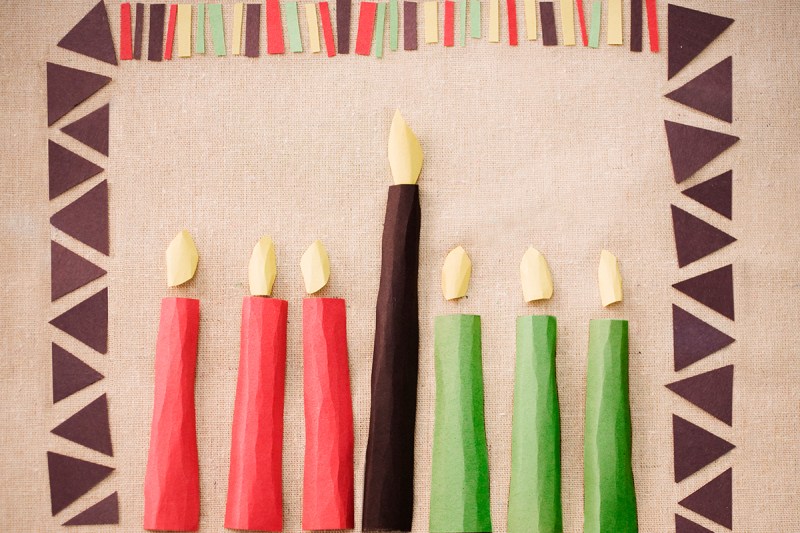
During Kwanzaa, a candle, representing one principle, is lit each day on a kinara. Observers would light the central black candle on the first day, then alternates between the red and green candles starting from the outer candles moving inwards on following days.

Unlike Hanukkah which is rooted in the Jewish religion, Kwanzaa is a cultural, not religious, holiday that was traditionally celebrated by African-Americans. Thus, Kwanzaa can be observed by non-Africans due to their universal values of unity and purpose, which were evident in their civil rights movements during the 60s.

Kwanzaa starts annually on December 26th until January 1st, while Hanukkah dates are based on Hebrew calendar month of Kislev, which varies between November and December of our usual Gregorian calendar (2).

Hanukkah with 7 principles, 7 candles on a “kinara” (Swahili word for candle holder).

Were you surprised to find many similarities between the two seemingly irrelevant traditions? 

Sources

  1. https://www.history.com/topics/holidays/hanukkah
  2. https://www.thesouthend.wayne.edu/features/article_de2cabe6-a67a-11e5-8f26-cb25d4e32df3.html

Featured photo (from Alma): Kwanzaa candles

Native American Heritage Month 2019: Quill Workshop

Standard

By Pinn Duong

On November 26th, quill master Jamie Jacobs held a workshop at GCC to share knowledge about Native American’s lost art of quillwork embroidery. Guest speaker and Tonawanda Seneca Jamie Jacobs is a collections assistant at the Rochester Museum and Science Center. His role at RMSC includes working as an education expert on Haudenosaunee (Iroquois) culture and as an anthropological consultant documenting Iroquois ethnological collections at the Museum. He graduated from Genesee Community College with an Associate Degree in Criminal Justice in 2006.

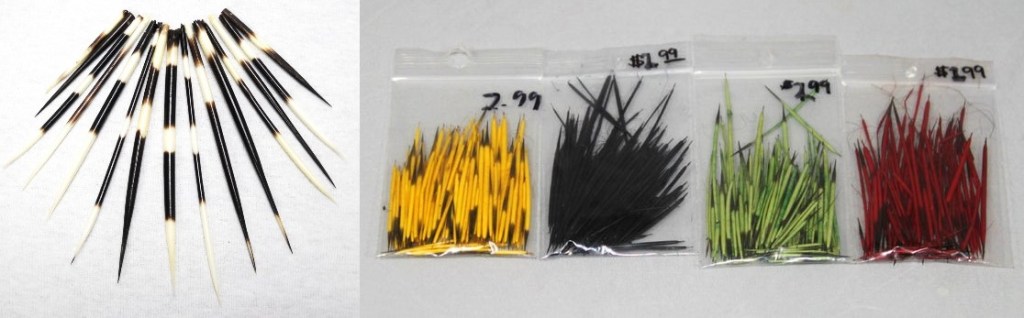
What does a quill look like when observed in close-up? A porcupine quill is a round, hollow tiny tube with a pointy end. A porcupine has around 30,000 quills on their back. So how do Native Americans obtain quills from porcupines? It’s easy to get quills from dead porcupines, but for living ones, native women had to sneak up behind the animal and throw a blanket over it. In natural defence, porcupines will raise its quills which will be stuck in the blanket. Quills are easily detached from the porcupines when touched. Like hairs, porcupines grow new quills to replace the ones they lost. Quills have sharp tips with microscopic backwards-facing barbs that clings to the skin, which make it difficult and (and slightly) painful to pull the quills out of an animal’s or human’s skin (1).

(Photo: AAAS) A zoomed-in of quills’ sharp tips and their backwards-facing barbs that make it difficult to pull the quills out of an animal’s or human’s skin.
(Photos: Land of Strange, Etsy) Porcupine quills before and after dyeing.

Once obtained from the porcupines, quills need to be cleaned with hot water (to avoid diseases if quills get stuck in the skin while working), dyed and flattened. Quills are softened in warm water again before embroidery. When glass beads became widely available from Euro-American traders around the 1850s, quillwork gradually became a lost art. Due to their durability, beads were read-made, easier to acquire, easier to take care of, quicker to embroider and were available in a wider range of colors. It can take more than a year for a master quill worker to quill a shirt, but with beads, it only takes a few months (2).

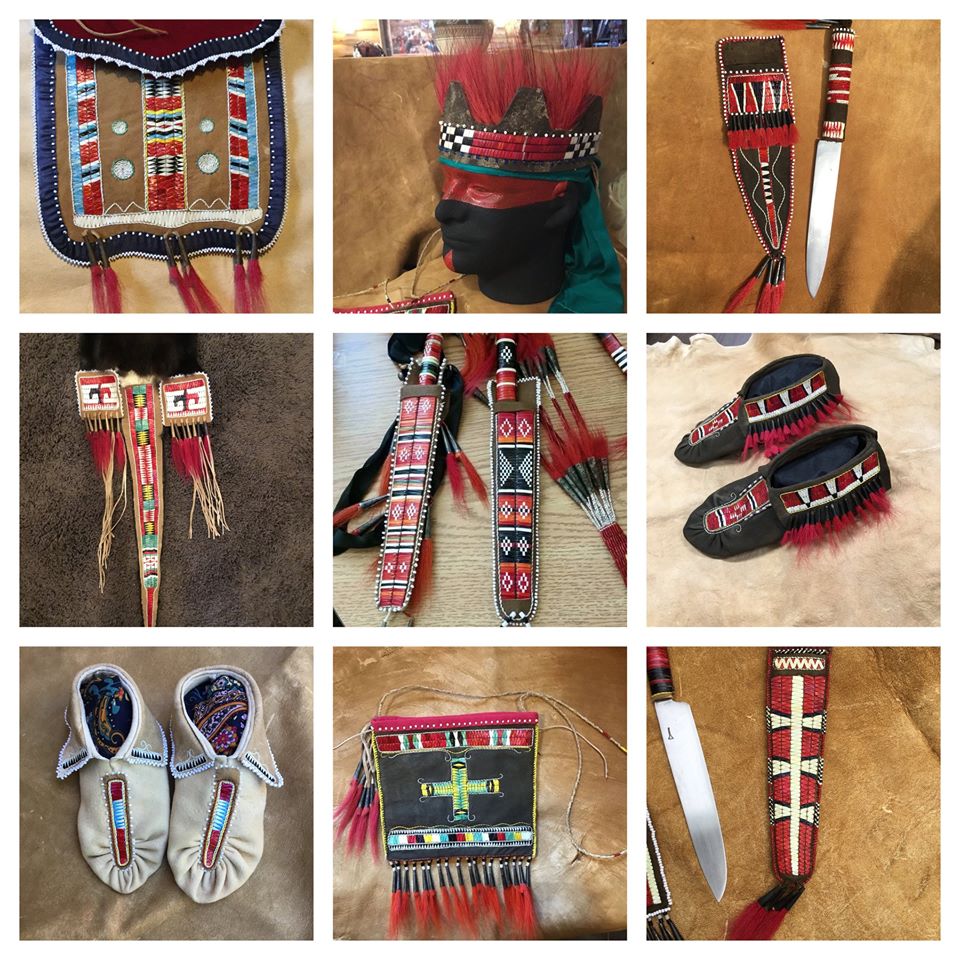
A fully-quilled purse made by a master quill artist, such as Jamie, can easily cost $1000-$2000, and they are sold out fast.

(Photo: Jacob’s Facebook) Jamie Jacob’s collection of his past quillworks.

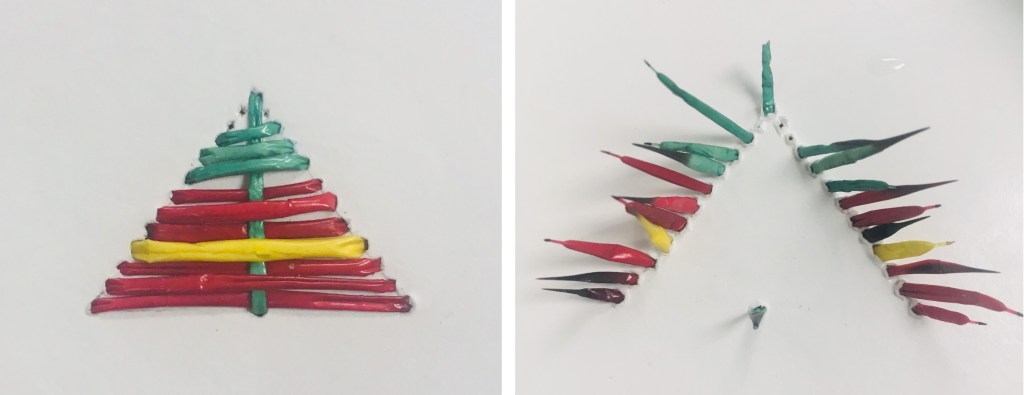
Though I was not able to create a $2000 quilled basket ready for sale during the one-hour workshop with Jamie, I did finish a tiny piece of crooked quillwork on paper and had a peek at the immense amount of diligence and time required of quill workers.

The front and back side of my amateur & crooked quillwork 🙂

Sources:

  1. https://powwow-power.com/quillwork/
  2. https://prairieedge.com/tribe-scribe/quillwork-a-vanishing-native-american-art/
  3. https://books.google.com/books?id=liCOtoUbbx8C&dq=quill+work+keep+women+at+home

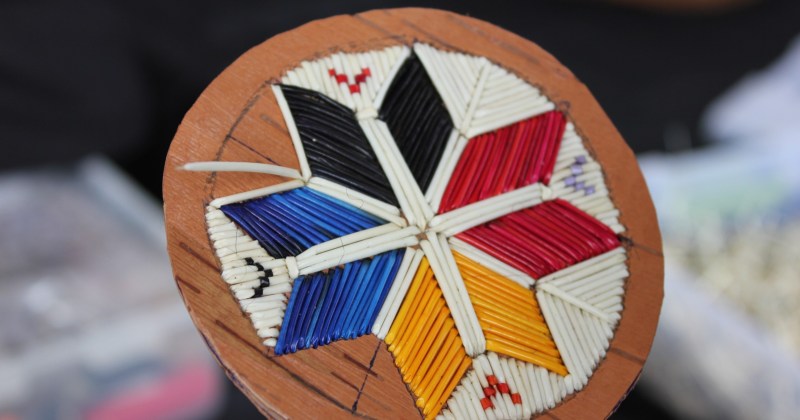
Featured photo (from Multicultural Kid Blogs): Quillwork on birchbark.